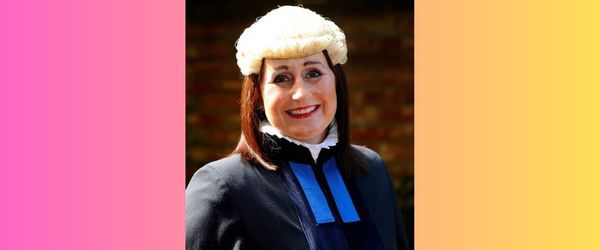
Sarah’s brain aneurysm story: A thunderclap out of nowhere
On July 5th 2025, Sarah Taylor's life changed in an instant. She had just finished a 5k open water swim and was walking her dog when it hit her: a thunderclap headache out of nowhere. She collapsed, and the next thing she knew, she was waking up in the back of a blue-lighted ambulance.
At Blackpool Vic, a CT scan with dye revealed a bleed on the brain. She was rushed to a specialist neurology hospital in Preston, where they found a massive ruptured aneurysm.

Over the next six weeks, she underwent three terrifying brain operations. They initially went in to coil the aneurysm, but after she was sent home, she suffered terrible pins and needles and head pain. A second bleed meant she needed an emergency craniotomy, leaving her with 22 staples in her head.
Finally, she had a third surgery to insert a stent and more coils. Within 24 hours of that final operation, she was discharged.
Training saved her life

Sarah's brain surgeon looked at her and said something she will never forget: if she had not been so incredibly fit, she would not have survived the rupture.
Before this happened, Sarah lived life at a million miles an hour. She joined the Royal Navy at 17 as military police and later spent twenty years as a forensic investigator for the Solicitors Regulation Authority, tackling complex malpractice cases.
When she turned 50, she decided to push herself out of her comfort zone and took up triathlons. By 52, she had completed a Half Ironman and was training up to 17 hours a week for a full Ironman in Leeds. She thought she was just training for a race, but her surgeon told her she had actually been training to save her life.
Navigating a hidden disability
To look at Sarah today, you would think nothing was wrong. Her surgeon noted she had "no deficits" because her face was not paralysed and she could walk. But cognitively, her world has shattered. The neuro-fatigue is completely debilitating. She gets easily overwhelmed and overstimulated, and she sometimes struggles to process information or find the right words.
It is incredibly frustrating when people tell her she "looks well" and ask why she is not back at work. They do not see the reality of struggling with sensory overload while waiting endlessly on hold with the DVLA, or fighting through 28-page DWP forms just to explain her hidden disability. After her initial community brain injury support suddenly stopped, she felt completely cast adrift, not even knowing what she was safely allowed to do physically.
Finding support through patient communities and HBA Support
She was also left with questions about her family history. She recently discovered there is a hereditary link to what happened to her. Her mum's sister had an aneurysm in her neck that caused a stroke, though she only learned the full details after her own rupture.
She says "When you are discharged, you are left alone wondering if you need to be scanned again, completely unsure of where to turn."
That is when Sarah found HBA Support. She was desperately searching the internet for answers and charities related to subarachnoid haemorrhages, and HBA Support appeared.
Sarah continues "They have been an absolute lifeline. Instead of frightening online forums, HBA offers definitive, practical guides on things like returning to fitness and flying safely, as well as information about the hereditary nature of brain aneurysms. They are also able to connect people like me with a community of people who truly understand what it is to live through this."
Sarah wants to share her story because the lack of information surrounding brain injuries is staggering. She believes survivors need better continuous medical care and clearer guidance so they are not expected to figure it out alone.
She is having to build a completely new game plan for her life, but with support, she finally feels like she has the guidance to do it.
Brain Aneurysm Resources and support
If you have any health concerns related to the topics in this article, please speak to your GP or a clinical professional.
Visit our Support page for free resources for people recently diagnosed with an hereditary brain aneurysm:
Share your story
Want to inspire and provide hope for others affected by hereditary brain aneurysms? If you'd like to share your own story please get in touch via the button below.